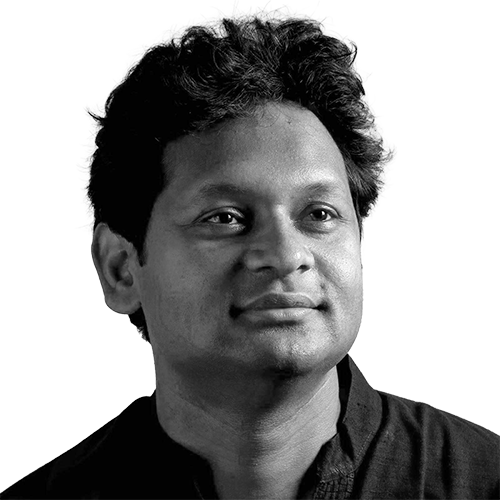
Saiful Huq Omi
Photographer, Filmmaker, Visiting Faculty
Saiful Huq Omi, born into a lineage of educators, traversed the disciplined realm of electronics and communication engineering to inhabit the ethically charged, epistemically rigorous field of documentary photography. His praxis encompasses photography, filmmaking, pedagogy, human rights advocacy, curatorial experimentation, and entrepreneurial engagement, all informed by a formative history of student activism that forged a critical consciousness attuned to power, memory, and representation. As the founder of the international photography school Counter Foto – A Center for Visual Arts, Omi cultivates a heterotopic space for visual inquiry, fostering modes of creative production that interrogate social, political, and aesthetic regimes. As editor of Counter Foto, Bangladesh’s preeminent Bengali-language photography journal, he mobilizes discourse across Asia, Europe, and North America, positioning pedagogy as an act of epistemic disruption. Globally recognized for sustained long-term projects, Omi’s work navigates the liminal terrains between visibility and erasure, power and marginality, and has been exhibited in 23 countries since 2006. His extensive engagement with the Rohingya crisis, spanning the United Kingdom, Bangladesh, Thailand, India, and Malaysia since 2009, produces counter-narratives to systemic violence and historical erasure, materialized in two of his nine publications. Recipient of the U.S. State Department IVLP fellowship, the Dutch Ministry of Foreign Affairs fellowship, and the Acumen fellowship, Omi’s practice is inseparable from its ethical and political stakes. Currently based in Dhaka, he engages in research-driven, socially critical projects: documenting Political violence in Bangladesh, tracing the longue durée of the climate crisis, photographing the Urdu-speaking community, and executing meticulous investigations into oppressed communities. He recently completed a documentary film, ‘Where Should We Go After the Last Border’, spanning seventeen years, which probes the politics of statelessness, genocide, and structural erasure, challenging the limits of representation while asserting the persistent presence of those made precarious by systemic violence, with the Rohingya crisis as its critical lens. He has published more than 10 books and is currently working on his third book on the Rohingyas.