


Photography is the most popular medium to capture life as it goes by. Travelling, meeting old and new friends, important events and tender moments-memories like these deserve to be captured for posterity. The Photography Foundation Course at SACAC, Delhi introduces the exciting world of photography to those who have the passion for it. The challenge of taking a good photograph is not just being present at the opportune moment; it’s also about the technical ability and knowledge to create an aesthetically evocative composition.
The course is powered by Olympus and supported by hama and Lexar.
Photography is one of the most popular, easily accessible and yet powerful mediums for documenting today’s time for posterity or even communicating as well as expressing. However, with dramatic shifts in socio-political environments across the globe, the audience’s sensibilities are also shifting. This calls for an urgent need for a shift in our communication mediums including visual communications.
Today, everyone with a smartphone is a photographer and even a citizen journalist. In such times, are techniques alone adequate, or do we need a deeper understanding of the visual language to help you distinguish your style from most others?
The five weekends digital still photography course at SACAC will introduce you to the technical aspects of photography through a structured programme that will build your knowledge and skills from the elementary level onwards. It will also introduce you to the nuances of the visual language, it’s grammar through simply illustrated lectures, which will eventually help you strengthen your photographic skills.
5
Weekends
10
Days
32
Hours
Curriculum
Weekend 1
Session 1- Introduction
- Understanding of Cameras (Analog/Digital, DSLRs and Mirrorless)
- Full Frame Vs APSC Vs MFT
- Megapixels and Image size
- Explaining Aperture
- Detailed explanation and demonstration on
- Aperture
- Shutter Speed
- Shutter Speed
- ISO
Weekend 2
Session 3- ISO (Sensitivity as the third and last parameter for controlling the exposure)
- Exposure in photography
- Exposure triangle
- Essential camera functions (Drive mode, Quality and Picture profiles)
- Exposure meter scale and Histogram
- Colour temperature and white balance
- Focal length
- Depth of Field
- Fundamentals of lensing : Focal lengths, Primes Vs Zooms, Angle of View
- Shooting in Manual Mode for complete control
- Demonstrations and Exercises in campus
Weekend 3
Session 5- Exploring Modes (A/Av , S/Tv, Program Mode)
- Focussing Modes
- Composition
- Field Trip
- Humayun’s Tomb/Safdarjung’s Tomb/Qutub Minar
Weekend 4
Session 7- Panning and Zooming (demonstration in and around campus)
- Exposure Compensation (Overriding camera’s automation)
- Revision of Aperture, Shutter Speed and ISO
- Revision of priority moods
- Review of Images
- Troubleshooting and clearing of concepts
- Discussion on camera Menu
Weekend 5
Session 9- Introduction to post-processing
- Learn how to edit images on the phone using the free yet powerful application ’Snapseed’.
- Understanding Jpeg vs RAW
- Power of Non-destructive image processing
- Optimal processing of RAW images in Adobe Camera RAW
- Processing Colour Vs Black & White images
- Available light Vs Studio Light
- Sync-speed and its effectiveness
- Types of studio lights (studio flash Vs continuous light)
- Overview of studio light (detailed explanation of display panel)
- Basic understanding of Light shaping tools and color gels.
- Practice session in studio with 'one point & two point setup’ in the guidance of our professional team
Curriculum for 7 Day Boot Camp
Class 1 & 2
- Photography as Light-writing
- Essentials of Camera-work( Aperture, Viewfinder, Focussing, shutter release)
- Kinds of Cameras( Analog/Digital, SLRs/Mirrorless, Small/Medium Format)
- Aperture (F-stops)
- Modes( M, A , S, P)
- Depth of Field : Blurring the non-focussed areas(Working in Aperture prioritymode)
- Essential Camera Functions( Drive, Image formats/ quality and Pictureprofiles)
- Shutter Speed
- Shooting motion (Freezing motion/ introducing motion blur in Shutter Prioritymode)
- Panning (demonstration)
- Exposure Compensation (Overriding camera’s automation)
- Demonstrations and Exercises
Class 3
- ISO (Sensitivity as the third and last parameter for controlling the exposure)
- Exposure
- Exposure meter scale and Histogram
- Exposure Triangle
- Benefits of Mirror-less for exposure preview
- Focussing Modes (Area and others)
- Focussing technologies for dynamic objects
- Shooting in Manual Mode for complete control
- Creative Composition
- Color Temperature and White Balance
- Demonstrations and Exercises
Class 4
- Fundamentals of Lensing : Focal lengths, Primes Vs Zooms, Angle of View
- Perspective matters
- Demonstrations and Exercises
- Field Trip
Class 5
- Review of Images
- Troubleshooting and clearing of concepts
- Available light Vs Studio Light
- Sync-speed and its effectiveness
- Types of studio lights (studio flash Vs continuous light)
- Overview of studio light (detailed explanation of display panel)
- Basic understanding of Light shaping tools
- Working with ‘one point’ set up
Class 6 & 7
- Introduction to post-processing
- Jpeg vs RAW
- Exploring Image size (Print & Web usage)
- Processing Black & White images
- Power of Non-destructive image processing
- Optimal processing of RAW images in Adobe Camera RAW
Skills Developed
- Operating a DSLR camera
- Develop a healthy understanding of different technical aspects of camera operation including lenses and how perspective shifts
- Superior technical skills and an aesthetic eye for high-quality compositions, ability to identify potential images and understanding of factors that lead to making of powerful images
- An eye for creating moody images using light and shadows
- Image editing using Adobe Lightroom


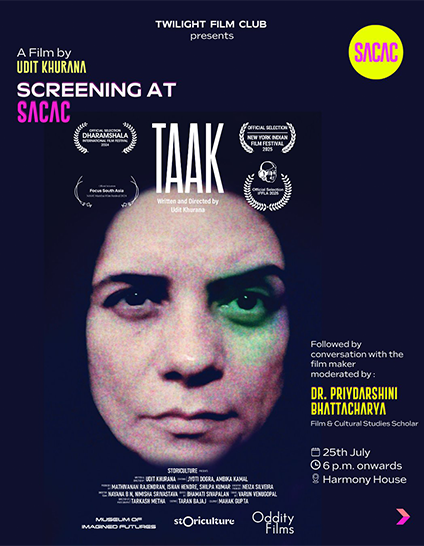
Twilight Film Club | Screening of Taak
The Twilight Film Club at SACAC hosted a screening of the award-winning short feature Taak (40 mins) by filmmaker Udit Khurana, curated by Shankhajeet De, on 25 July at Harmony House. The session, moderated by Dr. Priyadarshini Bhattacharyya, brought students, faculty, and film enthusiasts together for dialogue on cinema and culture. Taak follows Shalini, a […]
Date : 25th Jul 2025
Time : 6.00 PM
Know More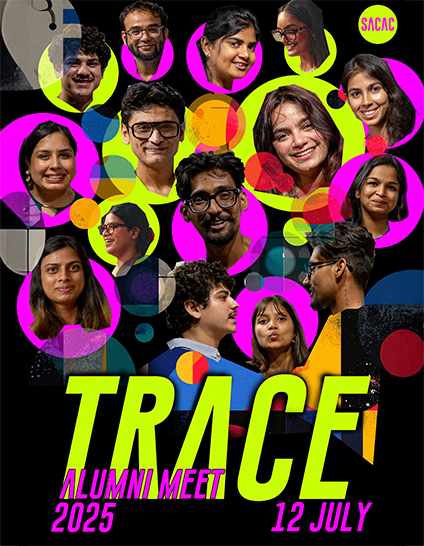
TRACE: Alumni Meet 2025
TRACE Alumni Meet 2025 brought together Advertising & PR graduates from the batches of 2015 to 2024, celebrating a decade of creativity and connection. The evening was filled with warmth, laughter, and nostalgia as alumni reunited with peers and mentors, sharing stories of their journeys since SACAC. Faculty members cherished seeing their students thrive as […]
Date : 12th Jul 2025
Know More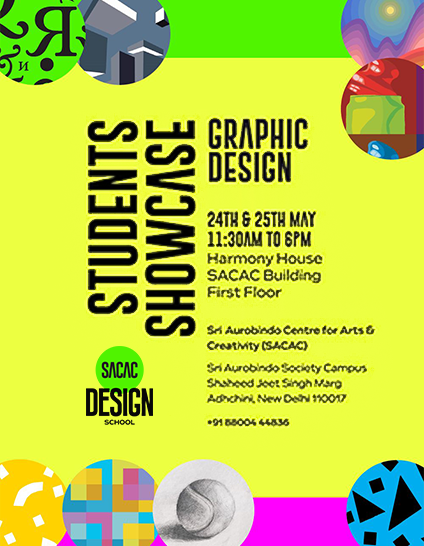
Students’ Showcase | Graphic Design Batch 2024–25
SACAC Design School proudly presented the Students’ Showcase by the Graphic Design Batch of 2024–25, marking the culmination of a six-month weekend course. The showcase reflected a transformative journey where creativity met discipline, evolving into compelling visual stories. Beginning with fundamentals of drawing, composition, color, and typography, students advanced to mastering digital tools like Adobe […]
Date : 24–25 May 2025
Time : 11.30 AM - 6.00 PM
Know More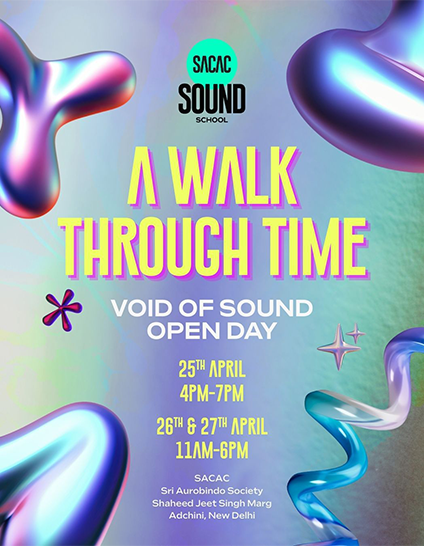
Void of Sound
Void of Sound, SACAC Sound School’s annual student showcase, engages critically with sonic practices while exploring new ways of listening. VOS focused on imagining time travel through sound, with students presenting experimental demos, speculative works, and interdisciplinary explorations. Spread across the SACAC campus from 25–27 April, the exhibition transformed spaces into immersive experiences featuring sound […]
Date : 25–27 Apr 2025
Time : 11.00 AM - 6.00 PM
Know More
Connecting with us is effortless. Fill out these details & we’ll get back to you shortly.
Lets Connect